What we know about Dessa: The mysterious voice AI from Block
Explore Block’s Dessa voice AI: its development timeline, speech-only training, realistic demos, local-use claims, and questions about access and safety.
Updated October 25, 2026. Header image: the Dessa wordmark and launch headline on Block’s official website, captured October 26, 2026. Image credit: Block.
A laugh halfway through a sentence. A surprised gasp. A listener who starts responding before you have quite finished speaking. These small moments are central to Block’s pitch for Dessa, the voice model it unveiled on October 23, 2026. The official demonstrations focus on the texture of conversation: how a voice joins in, reacts, hesitates, and changes with the person speaking to it.
For those of us following voice AI, that is an exciting direction. Expressive speech is compelling on its own; a model that can also judge when to speak, when to listen, and how to respond opens up a much bigger set of possibilities. Dessa’s creators make an especially intriguing claim: it learned from human conversation audio alone, without text or a pretrained model. Research lead Ragavan Thurairatnam’s announcement.
That leaves us with a fascinating mystery. How much understanding can emerge from listening? How well does it hold up outside the launch demos? And what happens when a machine’s voice carries the familiar signals that make us trust another person?
There is still a lot to learn. As of October 25, 2026, Block had shared recordings and invited selected safety researchers to apply for access, but had not made a public download, API, or general release date available on its Dessa page. Here is how the story reached this point—and what has us watching closely.
In this report
- Dessa’s development timeline
- The team’s earlier speech research
- The speech-only model announcement
- Local use and hardware requirements
- The demos and what they suggest
- Public reactions and concerns
- Access and what comes next
Dessa’s story so far
Dessa arrived in public this week, but the people and ideas behind it have a longer history. The timeline below traces that public history; Block has yet to share when work on this particular model began.
| Date | Development | Original sources |
|---|---|---|
| May–September 2019 | The original Dessa team shared its RealTalk voice synthesis work, then introduced an audio-deepfake detector. Realism and its risks were already part of the story. | Dessa’s account of the work |
| February 7, 2020 | Square acquired Dessa, bringing the Toronto company into the business now known as Block. | Acquisition announcement |
| October 23, 2026 | The new Dessa model was unveiled: speech-only training, full-duplex conversation, and a promise of local use. The team shared demos and opened applications for safety research access. | Thurairatnam’s launch · Dorsey’s announcement · Block’s invitation |
| October 24, 2026 | Public discussion widened from fascination with realism and local use to concerns about scams and whether assistants should behave this much like people. | Local-use reaction · Scam concern · Assistant-design debate |
| October 25, 2026 | The demos remained the main public window into Dessa. Broader access and the technical details needed to understand its capabilities were still to come. | Official website and research access |
2019–2020: a history of making voices convincing
Long before this launch, Dessa was exploring how convincingly machines could recreate a human voice. In a September 2019 post, the original company looked back at the Joe Rogan voice recreation it had shared in May 2019 using RealTalk. It also introduced a detector for synthetic audio.
That pairing is striking in light of today’s announcement: the same company was working on making voices more believable and on recognizing when a voice was artificial. RealTalk was an earlier synthesis project, separate from the conversational model unveiled this month, but it helps explain why the Dessa name is familiar to longtime followers of speech AI.
On February 7, 2020, Dessa announced its acquisition by Square, retaining its brand and Toronto headquarters. Block now describes the lab behind the new model as a small research team founded by former members of that startup and reporting directly to Jack Dorsey. Meet the current team.
The intervening years remain the least visible part of this story. We have a research lineage, an acquisition, and now a remarkably ambitious announcement. We do not yet have a public account of the experiments, setbacks, or breakthroughs that connected them.
October 23, 2026: learning conversation by listening
Thurairatnam introduced Dessa with a conversation video and an unusually bold description: a “GPT3 moment for speech.” The ambition was clear. His team was presenting a model that could learn conversational ability from speech itself and run on consumer GPUs. Original launch post.
Dessa is a full-duplex speech-to-speech model that you can run on consumer GPUs.
— Ragavan Thurairatnam (@RagavanThurair), excerpt · October 23, 2026 — view original post
The term full-duplex describes one of the most interesting parts: Dessa can listen while it speaks. Human conversation is full of overlapping signals—a quick acknowledgment, an interruption, a laugh that changes where a sentence is going. A system that handles those moments well could feel far more responsive than one that waits for a turn to end before deciding what to say.
Dorsey’s announcement leaned into that possibility, emphasizing emotion, pauses, and natural cadence.
We believe voice is the most natural way to interact with intelligence
— Jack Dorsey (@jack), excerpt · October 23, 2026 — view original post
A short exchange in the replies made the training story even more intriguing. Christopher Stanley asked which language model powered the voice. Dorsey answered:
speech to speech. no llm
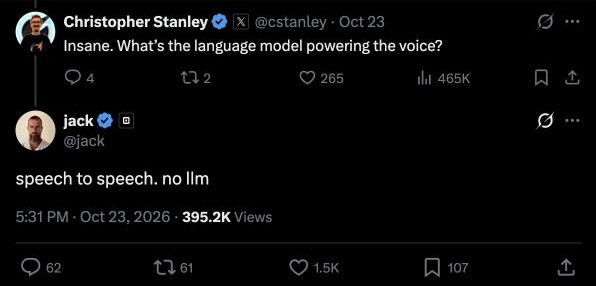
Read alongside Block’s description of training from scratch on conversation audio, the reply points to a question we would love to see the research unpack: how much of language, knowledge, and social timing can a model learn together through sound? “No LLM” does not tell us the architecture or how Dessa represents language internally. Those details are still missing, and they are part of what makes a technical report so worth waiting for.
There is a research history here, too. dGSLM in 2022 explored spoken dialogue learned without text labels, while Moshi in 2024 pursued real-time, full-duplex speech using a text language-model backbone. Dessa’s distinctive promise is the combination: realistic, responsive conversation learned solely from speech. Understanding how far it advances that work will take more than a launch video.
The promise of a voice model on your own computer
Dorsey also highlighted MacBook use. When Michael Urwin asked whether it could run locally, Dorsey confirmed it. Block specifies a MacBook Pro with M4 Max or better on its official page.
That prospect adds another reason to pay attention. If developers can eventually run this kind of conversation locally, they could experiment with experiences that depend less on a remote voice service. We still need the practical details—memory requirements, response latency, and what access or licensing will allow—before knowing how accessible that future is.
The training setup was much larger. Block says it trained Dessa on a single GB200 NVL72 rack, using hundreds of times fewer words than text LLMs, and claims faster-than-real-time inference. Block’s technical overview. NVIDIA’s rack specification lists 72 Blackwell GPUs and 36 Grace CPUs. The laptop claim concerns running the finished model; the rack concerns creating it. Block has not yet published the dataset size, comparison baseline, or measurements that would let us put its efficiency claims in perspective.
What makes the demos so intriguing
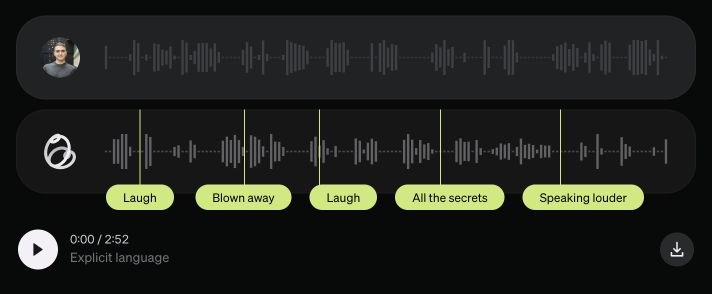
The moments Block chooses to highlight are revealing. There is laughter, help remembering a movie, surprise at an anniversary plan, and a change in volume when asked. These are the details that can make a conversation feel shared: the sense that the other voice is following the moment with you.
Block describes its six featured recordings as live conversations, with captions added afterward. The guide below follows the publisher’s descriptions and links directly to the players so you can explore the examples yourself.
| Recording | What to listen for, according to Block |
|---|---|
| Talking about the release | Laughter during speech and a louder response when asked. |
| Remembering a movie | Helping complete a thought and picking up the conversational turn. |
| An anniversary surprise | A gasp of surprise and a shift toward a softer, emotional delivery. |
| An expressive exchange | Changes in pace and intonation, with a joke followed by laughter. |
| Life advice | An empathetic-sounding response to a personal conversation. |
| A conversation with GPT-Live-1 | Two AI voices navigating interruptions and listener feedback. |
The GPT-Live-1 recording is especially interesting as a turn-taking example, though Block says the other developer is unaffiliated and has not endorsed Dessa. It is a conversation to inspect, rather than a controlled performance comparison.
Another launch-day clip widens the question beyond vocal expression. Thurairatnam shared intern Cara Ji playing a guessing game with Dessa, describing it as evidence of knowledge and reasoning learned from audio.
Dessa developed world knowledge and learned to reason purely from audio
— Ragavan Thurairatnam (@RagavanThurair), excerpt · October 23, 2026 — view original post
This is the capability we are most curious to understand. A model may sound wonderfully attentive, but can it follow a tricky explanation, notice a contradiction, or recover when it misunderstands? The game offers a glimpse of what the team is pursuing. Longer, unscripted use by people outside the lab would tell us much more about how dependable it is.
That distinction matters precisely because the voice is the draw. Convincing delivery can make an answer feel credible before we have checked whether it is right. As Dessa becomes available to more people, we want to learn about the quality of its understanding alongside the quality of its performance.
October 24, 2026: excitement, unease, and a question about what we want
By the next day, the public discussion was following several paths. Chubby (@kimmonismus) seized on the prospect of such a model running locally on an M4 Max Mac—a reaction to the announcement, rather than an independent hands-on report.
This voice model runs locally on an M4 Max Mac or better.
— Chubby (@kimmonismus), excerpt · October 24, 2026 — view original post
Others immediately imagined less welcome uses. Shiv Aroor’s quote-post put the scam-call concern bluntly.
Scam calls about to attain pandemic level.
— Shiv Aroor (@ShivAroor), excerpt · October 24, 2026 — view original post
The launch has not established that Dessa can clone a particular person or that it has been used for fraud. Still, the broader concern deserves attention: a voice that reacts naturally and sustains a believable conversation could make deceptive calls more persuasive. What disclosure, safeguards, and access rules will accompany that realism?
There is also a subtler question: how human do we actually want an assistant to be? @paoloanzn’s response acknowledged the realism while objecting to pauses, hesitation, and the feeling of simulated companionship.
when i talk to a model i want answers AS FAST AS POSSIBLE, AS SHORT AS POSSIBLE.
— 4nzn (@paoloanzn), excerpt · October 24, 2026 — view original post
We find that tension compelling. The small pauses that make a companion feel attentive might frustrate someone trying to finish a task. Warmth can make an interaction more comfortable, but it can also encourage us to read feelings or understanding into a system that has not demonstrated them. Dessa’s apparent strengths make those design choices more consequential.
Readers also asked about the training recordings. Block has not disclosed the dataset’s provenance in the materials reviewed. As more of a model’s appeal comes from the subtleties of human conversation, whose conversations it learned from—and how they were obtained—becomes a particularly important part of its story.
The next chapter is access
Block’s launch-day invitation to safety researchers offers the clearest indication of what comes next. It asked a small group to explore what Dessa can and cannot do; its research-access form was available when we checked on October 25, 2026.
Calling all AI safety researchers.
— Block (@blocks), excerpt · October 23, 2026 — view original post
We would like the next chapter to answer three connected questions:
- How deep does the understanding go? Longer conversations, unfamiliar subjects, different accents and languages, and recovery from mistakes would help reveal where fluent performance meets reliable capability.
- What does local use actually require? Memory, latency, available weights or an API, and license terms will determine who can build with Dessa. None was fully specified at our cutoff.
- How will realism be handled responsibly? Training-data disclosure and published safety findings would help us understand the risks around deception, trust, and emotionally persuasive voices.
For creators watching the wider voice-model space, there is a further question: which of these conversational abilities might eventually become useful creative controls? Dessa has not been presented as an available dubbing or script-to-voice product. Its appeal today is different from the narration and performance controls in our ElevenLabs V4 and FishAudio Drama 3 comparison, but the interest in more expressive voices connects them.
Dessa has given us plenty to be curious about. The possibility of learning both what to say and how to participate in a conversation from audio alone is a compelling research direction. Now we want to see what happens when more people can interrupt it, confuse it, challenge it, and spend enough time with it for the novelty to wear off. That is where its capabilities—and the harder questions raised by its realism—will become much clearer.