How to Create Character Voices with AI Text to Speech (+ 15 Prompts)
Learn how to create original character voices with AI text to speech. Copy 15 prompts for heroes, villains, creatures, narrators, and game characters.
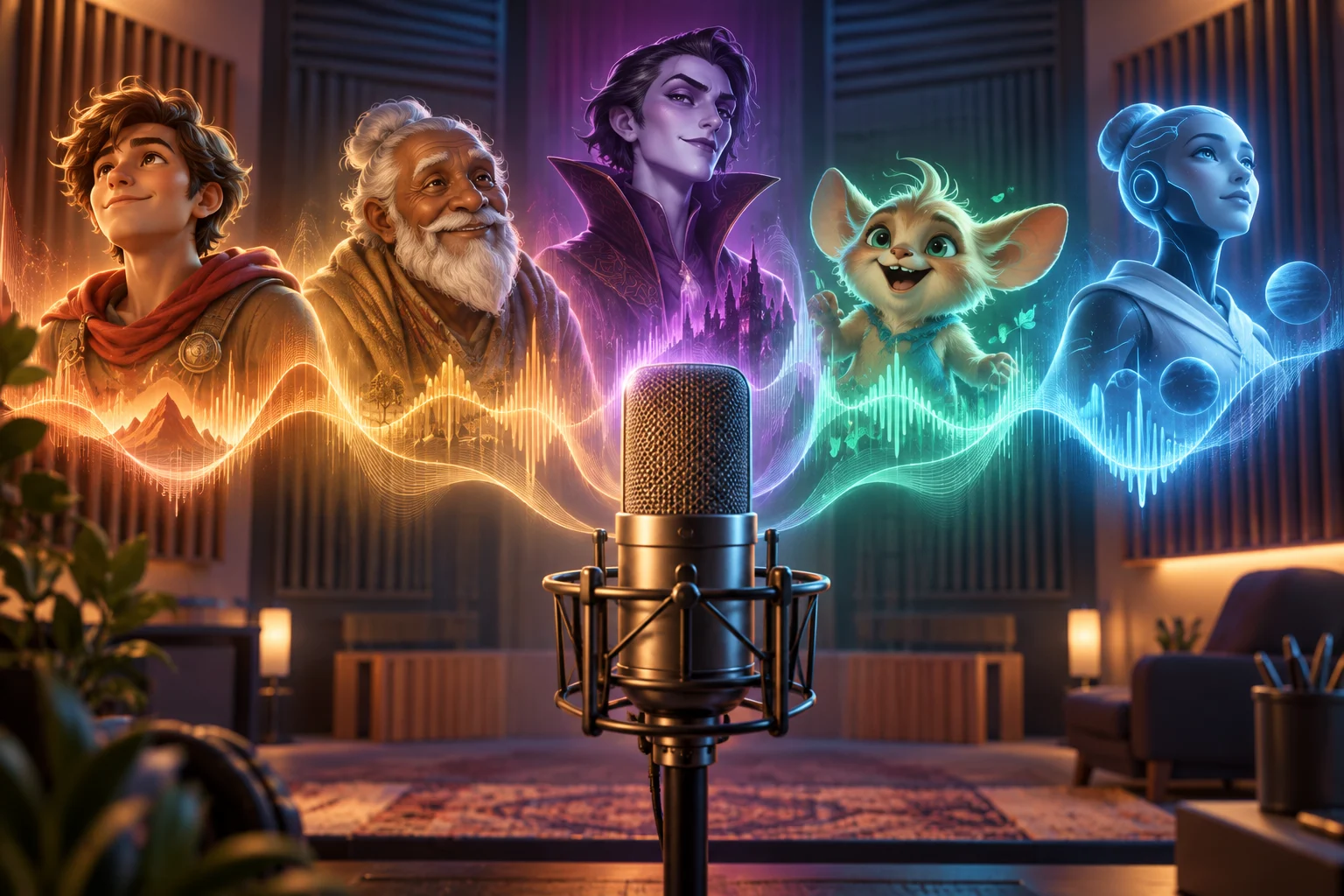
A memorable character voice is not just “deep,” “cute,” or “evil.” It has a physical texture, a rhythm, an emotional point of view, and a reason for speaking the way it does.
An AI character voice generator can turn those choices into spoken dialogue without a recording session. The useful part is not selecting a famous voice from a list. It is describing an original speaker clearly enough that the text-to-speech model has a role to perform.
This guide gives you a reusable character-voice formula and 15 copyable prompts for games, animation, audio stories, prototypes, and videos. Every prompt describes a fictional speaker rather than a real actor or an existing character.
Want to hear one with your own dialogue? Open the text-to-speech generator, paste a short line, copy a prompt below into the voice-description field, and generate a take.
In this guide
- What makes a good AI character voice?
- A reusable character voice prompt formula
- 15 AI character voice prompts
- How to create a character voice with AI text to speech
- How to keep a character voice consistent
- Common character voice prompt mistakes
- Frequently asked questions
- Create your own AI character voice
What makes a good AI character voice?
Start with the character, not an audio effect. A strong voice description answers five questions:
- Who is speaking? Give the character an approximate age, role, and vocal range.
- What does the voice feel like? Describe its texture: clear, breathy, resonant, nasal, gravelly, delicate, metallic, or warm.
- How do they speak? Set the pace, rhythm, pauses, diction, and volume.
- What are they feeling? Name an emotional baseline and explain whether it changes during the line.
- What should the model avoid? Rule out the most likely wrong performance, such as shouting, trailer-style drama, or a flat corporate read.
“Old wizard voice” leaves nearly every decision open. “An elderly scholar with a papery baritone, patient pauses, precise diction, and quiet delight whenever he discovers something” gives the model a playable character.
A reusable character voice prompt formula
Use this template as a starting point:
A [age range] [character role] with a [vocal range] voice and [texture].
Use [accent or pronunciation direction], [pace], and [speech rhythm].
The character feels [emotional baseline] while trying to [immediate intention].
Emphasize [specific performance behavior], then [emotional or pacing change].
Keep every word intelligible. The voice must sound [desired qualities], never [qualities to avoid].
You do not need to fill every bracket. Add only traits that change the performance. If an accent is not important, omit it. If the scene turns emotionally, describe when the turn happens instead of stacking contradictory adjectives at the beginning.
15 AI character voice prompts
These prompts are intentionally specific enough to copy, but general enough to adapt. Replace the age, accent, emotion, or pace to fit your character and world. Four include playable, unedited outputs generated with the same Qwen3 voice-design model used by our text-to-speech tool.
1. Adventurous young hero
Use this for an optimistic protagonist entering a new world, beginning a quest, or trying to rally a nervous team.
A young adult adventurer with a bright, clear tenor voice and lightly textured warmth. Speak with energetic forward momentum, natural conversational phrasing, and crisp diction. The character is excited but not fearless; let a brief flicker of uncertainty appear before each important decision, then return to determined optimism. Keep the delivery human and grounded, never like a booming movie trailer.Sample line: “The map ends here, which means the next part belongs to us.”
Why it works: Confidence and uncertainty coexist, giving the hero somewhere to grow.
2. Warm elderly storyteller
Choose this voice for folklore, a fireside narrator, a village historian, or the opening of a gentle fantasy story.
An elderly storyteller with a warm low baritone, soft rasp, and an intimate fireside presence. Use unhurried pacing, rounded vowels, gentle breaths, and small pauses before important images. The character enjoys sharing a familiar story and smiles quietly at details the listener does not yet understand. Sound wise and welcoming, never frail, sleepy, or theatrical.Sample line: “Long before the road had a name, a blue lantern waited at its final bend.”
Why it works: The prompt directs both vocal age and the narrator’s relationship with the listener.
3. Refined fantasy villain
Use this for an antagonist whose control is more threatening than shouting.
A poised fantasy antagonist in their forties with a smooth velvet contralto and precise, elegant diction. Speak slowly at a comfortable volume, allowing deliberate silence after polite phrases. The character is amused by everyone in the room and never needs to prove their authority. Let one moment of cold impatience cut through near the end, then recover immediately. Sound sophisticated and dangerous, never snarling, breathless, or cartoonishly evil.Sample line: “You may keep the crown. I came for the promise beneath it.”
Why it works: Restraint creates menace without relying on a generic growl.
4. Cheerful cartoon sidekick
This prompt fits an original animated companion, tiny creature, or enthusiastic helper.
A small, cheerful cartoon sidekick with a light youthful voice, springy rhythm, and a slightly breathy laugh hidden between phrases. Speak quickly but keep every consonant clear. The character treats even minor discoveries as wonderful news and becomes more excited with each sentence. Use playful upward inflection without turning the voice squeaky, frantic, or babyish.Sample line: “I found the key! I also found three buttons, a spoon, and something that might be a moon.”
Why it works: Specific rhythm and escalation create energy while the avoid-list keeps the voice usable.
5. Battle-weary commander
Use this for a veteran leader addressing a team before a difficult mission.
A battle-weary commander in their late fifties with a low, weathered voice and restrained authority. Use economical phrasing, steady breath, clipped pauses, and a quiet volume that makes others lean in. The character is exhausted but fully alert, carrying private grief without allowing it to interrupt the order. Let warmth appear briefly when addressing the team, then finish with calm resolve. Never shout or sound like a recruitment advertisement.Sample line: “We have one road left, so we take it together and we bring everyone home.”
Why it works: Authority comes from control and history rather than loudness.
6. Curious teenage inventor
Choose this for a clever student, mechanic, alchemist, or gadget-building game character.
A teenage inventor with a clear mid-range voice, quick thoughts, and slightly uneven pacing. Begin each idea carefully, then accelerate as the character becomes absorbed in the explanation. Add tiny self-corrections, delighted emphasis on technical discoveries, and one short breathless laugh. The character is brilliant, curious, and socially sincere, never smug, childish, or chaotic.Sample line: “Technically it was an accident, but it was an extremely repeatable accident.”
Why it works: Changes in pace make the intelligence feel performed rather than merely stated.
7. Nervous space-station engineer
This voice works for a science-fiction log, emergency repair scene, or crew conversation.
An adult space-station engineer with a practical, slightly nasal voice and understated delivery. Speak in short diagnostic phrases with controlled breathing and precise technical diction. The character is trying to sound routine while becoming increasingly worried by an impossible instrument reading. Let the pauses grow longer and the final sentence become quieter. Keep the fear restrained, never panicked or melodramatic.Sample line: “The sensor is working. That is the part I was hoping not to confirm.”
Why it works: A clear performance arc turns a simple status report into a scene.
8. Dry private detective
Use this for noir-inspired narration, a mystery game, or a character who hides concern behind humor.
A tired private detective in their forties with a smoky mid-low voice and dry conversational delivery. Use measured pacing, downward inflection, and short pauses that suggest the character is editing each thought before sharing it. The humor is understated and defensive, with genuine concern briefly visible underneath. Sound observant and world-weary, never like a parody of an old film announcer.Sample line: “The office was empty, except for the footprints and the man insisting he had never been there.”
Why it works: The prompt defines what the sarcasm is protecting, which adds emotional depth.
9. Gentle forest guardian
Pick this for a peaceful creature, nature spirit, healer, or patient guide.
A timeless forest guardian with a soft resonant alto, airy texture, and calm natural cadence. Speak slowly without dragging, using gentle emphasis and quiet pauses that feel attentive rather than sleepy. The character is protective, compassionate, and slightly amused by hurried visitors. Let the voice become firmer for the warning, then return to warmth. Never whisper so heavily that the words become unclear.Sample line: “You may cross the river, but leave the silver stones where they are dreaming.”
Why it works: A controlled contrast between warmth and firmness gives the guardian authority.
10. Mischievous trickster
Use this for a rogue, magical nuisance, puzzle-giver, or unreliable guide.
A quick-witted trickster with an agile androgynous voice, bright tone, and playful precision. Vary the rhythm: rush through obvious facts, pause before misleading details, and place delighted emphasis on loopholes. The character enjoys the conversation more than the outcome and is always one thought ahead. Keep the performance charming and readable, never manic, shrill, or randomly giggling.Sample line: “I promised not to open the door. Nobody said anything about removing the wall.”
Why it works: Timing communicates mischief more effectively than simply asking for a “funny voice.”
11. Ancient dragon scholar
This is suited to an original dragon, immense creature, or nonhuman keeper of forgotten history.
An ancient dragon scholar with a vast, resonant bass voice, rough mineral texture, and exceptionally careful diction. Use very slow pacing, deep controlled breaths, and long thoughtful pauses, as if each sentence has been considered for a century. The character is intellectually curious and mildly impatient with short-lived visitors. Keep the voice articulate and dignified, never roaring, growling continuously, or obscuring the words.Sample line: “Your empire is the fourth to place that flag on my mountain.”
Why it works: Scale comes from breath and timing, not from sacrificing intelligibility.
12. Upbeat game tutorial guide
Use this for onboarding, item explanations, quest instructions, or a friendly in-world assistant.
An upbeat adult game guide with a clear neutral voice, friendly smile, and brisk instructional pace. Separate each action with a clean pause, emphasize verbs and important object names, and keep the energy encouraging without sounding like an advertisement. The character genuinely wants the player to succeed and stays patient after mistakes. Sound helpful, confident, and concise, never condescending or overly excited.Sample line: “Place the crystal in the empty slot, step back, and give it one second to wake up.”
Why it works: The delivery serves comprehension while still feeling like a character.
13. Eccentric magical shopkeeper
Choose this for a merchant, collector, potion seller, or comic supporting character.
An eccentric magical shopkeeper in their sixties with a reedy mid-high voice, precise articulation, and a confidential conversational tone. Speak in quick clusters followed by suspiciously long pauses. The character is delighted by rare objects, reluctant to discuss prices, and easily distracted by improbable memories. Keep the performance clever and controlled, never incoherent, wheezy, or offensively caricatured.Sample line: “The compass points toward what you need, which is why I strongly recommend ignoring it.”
Why it works: The rhythm reveals personality before the script explains it.
14. Calm synthetic starship guide
Use this for a futuristic assistant that feels intelligent and reassuring without copying a familiar movie AI.
An original synthetic starship guide with a smooth low-neutral voice, immaculate diction, and subtle harmonic warmth. Use even pacing and precise pauses, with only a small lift in pitch when offering reassurance. The guide understands human anxiety and is learning how to comfort the crew, so allow one gently awkward attempt at humor. Sound calm and newly empathetic, never cold, ominous, or mechanically monotone.Sample line: “The route is safe by every measurement we still consider reliable.”
Why it works: A small emotional contradiction makes the synthetic speaker feel specific.
15. Determined young rival
This voice fits an original animation or game rival whose competitiveness hides genuine respect.
A determined young rival with a focused mezzo voice, crisp consonants, and controlled athletic energy. Speak quickly during challenges, slow down when admitting respect, and let frustration tighten the voice without becoming a shout. The character is proud, disciplined, and secretly pleased to have found a worthy opponent. Finish with a confident upward lift. Never sound cruel, childish, or like an imitation of an existing animated character.Sample line: “Do not mistake this for kindness. I need you at your best when I win.”
Why it works: The emotional subtext separates the rival from a one-note antagonist.
How to create a character voice with AI text to speech
1. Test one revealing line
Start with a sentence that contains an emotional turn, an unusual name, or a change in pace. A neutral line such as “Welcome to the village” does not reveal much about the performance.
AI Dubbing accepts up to 5,000 script characters per generation, but a one- or two-sentence test is faster to evaluate while you are finding the voice.
2. Describe the speaker and the performance separately
In the text-to-speech tool, put the dialogue in the script field. Put the age, vocal range, texture, emotion, accent, pace, and acting direction in the voice-description field. Do not mix stage directions into the spoken dialogue unless you want them read aloud.
Choose the script language or use auto-detect. If pronunciation matters, include character names and invented terms in the test line so you can hear them before generating a longer scene.
3. Preview, revise, and download
Listen for three things: whether the character is recognizable, whether every word remains clear, and whether the emotional turn lands where intended. Change one part of the description at a time—for example, pace or intensity—then generate another take.
When the performance works, download the audio and place it in your game, animatic, podcast, or video editor.
How to keep a character voice consistent
Text-described voice generation is generative. Reusing a prompt improves continuity, but it does not guarantee that every take will have an identical voice identity.
Use a simple “voice card” for each recurring character:
Character: Mara, station engineer
Canonical voice: Adult woman with a practical mid-low voice, lightly nasal texture,
precise technical diction, controlled breathing, and understated delivery.
Default emotion: Competent, alert, quietly skeptical.
Default pace: Short diagnostic phrases with clean pauses.
Avoid: Melodrama, breathless panic, corporate narration.
Pronunciation notes: Caelum = KAY-lum; Veyra = VAY-rah.
Then follow four rules:
- Reuse the canonical description exactly instead of rewriting it from memory.
- Keep the same language selection and pronunciation notes.
- Generate related lines in short batches with similar emotional context.
- Save the strongest take as a reference for your own review, even though this tool does not accept reference audio for cloning.
For a final commercial production that requires the same identifiable performance across many hours of dialogue, plan for a dedicated persistent voice workflow or a human actor. Voice-design TTS is especially useful for exploration, prototypes, short scenes, and discovering the direction before casting.
Common character voice prompt mistakes
Using only personality adjectives
“Brave, funny, mysterious” describes a character but not a sound. Add vocal range, texture, pacing, and observable performance behaviors.
Combining contradictory directions
“Very fast, slow, relaxed, panicked, whispering, and loud” gives the model no priority. Describe a sequence instead: calm at first, faster after the warning, quiet on the final sentence.
Asking for a famous voice
Do not request an imitation of a living actor, celebrity, or recognizable character performance. Build an original voice from age, timbre, rhythm, emotion, and role.
Adding effects to the voice prompt
Generate a clear performance first. Add telephone filters, cave reverb, radio distortion, or other environmental effects afterward in an audio editor. Separating performance from processing preserves clarity and gives you more control.
Changing every variable at once
If a take is nearly right, revise one dimension. Lower the pace, reduce the rasp, or make the emotional turn more restrained. A complete rewrite makes it difficult to learn which instruction improved the voice.
Frequently asked questions
What is an AI character voice generator?
An AI character voice generator turns written dialogue into speech for a fictional character. Some tools use preset voices; voice-design tools let you describe traits such as age, pitch, texture, accent, emotion, and pace in plain language.
How do I make an AI character voice sound unique?
Combine a specific vocal range and texture with a speaking rhythm, emotional baseline, role, and performance direction. “Gravelly villain voice” is too broad. Describe how the character breathes, pauses, emphasizes words, and changes during the line.
How can I keep an AI character voice consistent?
Save one canonical voice description, reuse it without casual rewrites, keep the same language setting, and generate short batches with similar scripts. Compare every take because generative voice design can still vary.
Can I copy the voice of a famous actor or fictional character?
Create an original voice from general traits instead of asking to imitate a real person or reproduce a recognizable copyrighted performance. AI Dubbing’s TTS page designs a new voice from a written description; it does not clone from a reference recording.
Can I use AI character voices in games and videos?
AI character voices can be useful for prototypes, animatics, original games, stories, explainers, and social videos. Before commercial publication, confirm that you own the script and other source material and review the current terms that apply to your account and project.
Create your own AI character voice
Pick one prompt from this guide and replace three details: the role, emotional intention, and speaking rhythm. Test it with a short line that reveals the character under pressure. If the first take misses, revise one instruction and try again.
Create an original character voice with AI text to speech, or explore the analog horror voice prompts for a more restrained, unsettling performance style.